

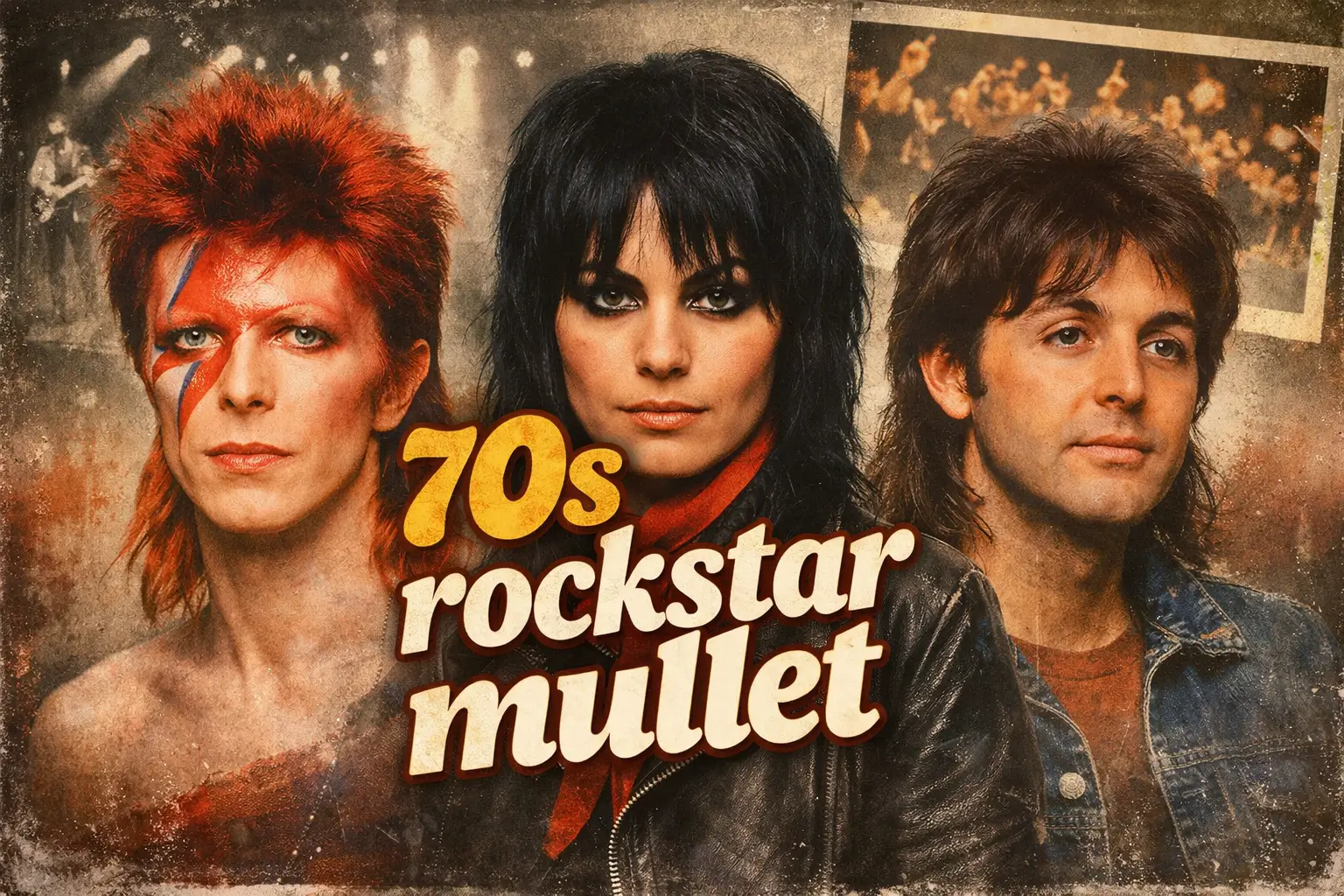
The 70s rockstar mullet wasn’t born as a joke, a meme, or a dare. It came out of a decade that loved rule-breaking, blurred lines, and hair that looked like it had lived a little. Long before the over styled, over-permed versions of the 1980s, the mullet of the 1970s was loose, shaggy, and unapologetically cool.
This was hair that moved when you walked. Hair that didn’t care if it looked “finished.” And that’s exactly why it still works today.
Where the 70s Rockstar Mullet Really Came From
Technically, the haircut wasn’t even called a mullet at first. In the early ‘70s, stylists referred to it as a bi-level cut, shorter in the front and sides, longer in the back, but blended with intention. The goal wasn’t shock value. It was balance.
What set the 70s rockstar mullet apart was its shag influence. Layers were cut unevenly, often with razors or point-cutting, so nothing felt stiff or symmetrical. The crown stayed light and airy, the fringe feathered forward or flicked back, and the back flowed instead of hanging like a curtain.
Glam rock played a huge role here. Artists were experimenting with gender expression, stage personas, and fashion as performance. Hair followed suit. It became softer, expressive, and deliberately imperfect.
Icons Who Made the 70s Rockstar Mullet Immortal
You can’t talk about this haircut without mentioning David Bowie. During his Ziggy Stardust era, Bowie’s fiery red mullet wasn’t just a hairstyle. It was a manifesto. Spiky at the crown, razor-sharp at the sides, and longer in the back, it pushed the mullet into avant-garde territory while keeping that shaggy movement intact.
Then there’s Joan Jett, whose jet-black shag-mullet became a blueprint for punk and hard rock. Hers was messier, tougher, and more grounded. It proved the 70s rockstar mullet wasn’t about glam alone. It could be raw and confrontational, too.
Even Paul McCartney played a part. His softer, feathered version helped bring the look into the mainstream. It was less theatrical but just as influential, showing how adaptable the style could be.
What all these versions shared was ease. None of them looked overly styled, and that was the point.
Why the 70s Rockstar Mullet Worked for Everyone
One of the most underrated aspects of the 70s rockstar mullet is its androgynous appeal. This wasn’t a “men’s cut” or a “women’s cut.” It was just hair. Long, short, sharp, soft. It could shift depending on who wore it.
The layered structure made it surprisingly forgiving across face shapes. Height at the crown helped elongate rounder faces. Soft texture around the jaw balanced square features. Oval and heart-shaped faces barely had to try. The feathered fringe did the work for them.
Because the cut relied more on texture than precision, it adapted easily. Straight hair leaned feathered and flicked. Wavy hair went fuller and more lived-in. Even curls could work if the layers stayed light and intentional.
Cutting and styling the 70s Rockstar Mullet the Right Way
This haircut lives or dies by how it’s cut. Blunt lines are the enemy. The original 70s rockstar mullet depended on point-cutting and feathering to avoid anything bowl-shaped or heavy.
A good rule of thumb is keeping the back about four inches longer than the front. That contrast creates the silhouette without tipping into parody. The crown should always be lighter than you think it needs to be.
Styling-wise, less really is more. In the 1970s, heavy gels and stiff sprays weren’t the goal. Volume came from blow-drying with a round brush, flicking the ends away from the face. Texture came from natural oils, movement, and a bit of chaos.
Modern products can help, but only if they stay matte. A light volumizing mousse at the roots adds lift. Sea salt spray or texturizing powder gives separation and grip. If you need hold, a dry clay works better than anything shiny.
The haircut should look better on day two than day one. If it doesn’t, something went wrong.
The Modern Revival (And Why It Feels Familiar)
Today’s “wolf cut” and modern mullet trends are basically the 70s rockstar mullet in new clothes. The DNA is the same. Shaggy layers, textured fringe, and movement over precision.
Artists and actors have helped bring it back into focus. Miley Cyrus leaned hard into a Joan Jett–inspired shag-mullet, complete with choppy layers and attitude. Paul Mescal and Jacob Elordi popularized quieter, softer versions that rely on natural waves instead of sharp fades.
Meanwhile, Rihanna and Zendaya have shown how fashion-forward the silhouette can be when pushed in unexpected directions.
None of these looks feel forced. That’s why they work.
The 70s Rockstar Mullet and Its Lasting Influence
The 70s rockstar mullet has survived decades of jokes, backlash, and reinvention because it was never meant to be neat. It was designed to feel personal. A little wild. Slightly unfinished.
In a world obsessed with clean fades and algorithm-approved haircuts, that kind of individuality stands out. The style invites customization. It encourages texture. It doesn’t ask for perfection.
That’s why it keeps coming back. Not as nostalgia, but as rebellion with good bones.
If you’re going to wear a mullet, the 70s rockstar version is the one worth copying. Not because it’s trendy, but because it never tried to be.
